Not financial or fundraising advice. See full disclaimer.
The next generation of sodium batteries: why we invested in TaiSan
Last updated
September 18, 2026

The next generation of sodium batteries: why we invested in TaiSan

In July we shared Adeline's participation in TaiSan's £4.65M seed round.
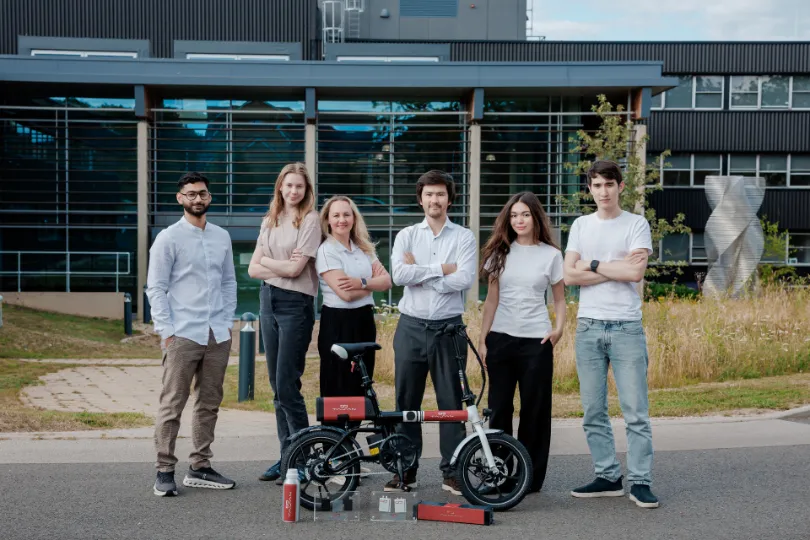
As with most deals, the story goes back a lot further. Sanzhar Taizhan and his team first caught my attention at a Deep Tech Demo Day side-event last November.
Sanzhar was pitching a novel sodium-ion battery. He had a great pitch, great investors, and a solid product. It's widely understood that our dependence upon lithium has serious drawbacks for the energy transition: the batteries are flammable for one; they also rely on scarce materials which pose a supply chain risk. But lithium-free alternatives have struggled to break into the market.
So what was different about TaiSan?
A couple of things stood out in our initial chat on the sidelines. Firstly, Sanzhar was a self-confessed 'battery geek'. I am always interested in what I call founder spikes - the areas where a founder just indexes off the charts. Besides his experience as a battery scientist at Jaguar Land Rover and the Faraday Institution, Sanzhar had multiple UK battery awards and was a three time team-finalist in SpaceX global contests. He knew and understood top automobile and micromobility players. Put simply, I could not imagine a better battery founder.
Secondly, the tech was genuinely differentiated.
It competed with lithium on energy density. Unlike many competitors working with sodium, it also did not rely on a flammable liquid electrolyte.
But perhaps most importantly, it enabled a key distribution advantage. As Sanzhar told me, he was not planning to build a gigafactory, but rather pursue 100% drop-in compatibility with existing lithium-ion manufacturing. This enabled capital-light scaling via licensing and materials supplies, rather than multi-billion dollar capex builds. Eliminating the hardware risk differentiated TaiSan from much of the competition, and made it a lot easier to believe that their approach was going to be the category winner.
From that point on, every conversation we had was top-notch. Looking back at my notes, TaiSan rapidly checked the boxes on the three pillars I examine for every startup: distribution yes, but also their tech moat, and the velocity of their progress. Their tech was also solid, passing a third party due-diligence assessment with flying colours.
What I really remember throughout the process is that Sanzhar consistently came across as a high calibre founder: technically rooted and experienced, but also humble. He was not your typical 'alpha bro' and yet he had the qualities to win in negotiations time and again from equity to customer contracts. We saw this repeatedly, from reference calls to in-person meetings at our office. It goes to show that cookie-cutter founder profiles are not the only option.
We also felt fully aligned with TaiSan's vision for the future. Large scale electrification must not be bottlenecked by resource scarcity and safety risks. We see a massive market for a lithium-free alternative that matches on performance, and Sanzhar and team positioned to win it. We look forward to supporting them on the journey.
Adeline Arts and Science participated in TaiSan's £4.65M seed round, co-led by Eos Advisory and the Midlands Engine Investment Fund II through Mercia Ventures.
Featured Orgs
No items found.


Why rest is still today's most radical productivity hack
If being bored is the key to greatness, are you out of practice? Adeline's Liz Bennett on the power of deliberate rest in an era of AI hustle culture.
The AI operating system for private capital: why we invested in Capsa AI
Adeline Arts & Science has backed Capsa AI, joining their $18 million Series A co-led by TX Ventures and Pivot Investment Partners. Capsa turns a private capital firm's accumulated deal history and institutional knowledge into a live intelligence layer, surfacing insights and automating the critical workflows that matter most for investment teams.
.svg)